Main page
|
Standard E9
|
Modal E9
|
Custom tunings
|
Other custom setups
|
Steel & Tonnetz
This is my attempt at listing out all of the relevant chords and variations relative to multiple positions, accounting for implicit modal quality (ie beyond just maj/min). For the sake of brevity, there's no tablature whatsoever here; grips will have to be inferred from the interval chart. I've tried my best to be thorough, but there are more than likely a few mistakes here and there so if anything looks to be obviously wrong, trust your judgement. I'll of course continue to expand this page as I figure more stuff out.
It's worth mentioning that I don't know much of anything about C6, and I don't have much interest in learning about it since I don't have access to a double neck. Also, just looking at the copedent, I get the impression that it's bespoke to a specific play style due to it having irregular combinations instead of uniform chord changes, so it likely wouldn't fit with the system that I've set up for E9.
Everything here will be based on a slight variation of the Emmons E9 copedent with three pedals and four levers. I've given each change a new letter since I wanted to reserve A-G exclusively for note and chord names and I've seen E and D used interchangeably for the EvD# drop. I figured that regardless of the naming scheme I use it'll end up being confusing to some degree no matter what, so I'll just make one that makes sense to me.
It seems to be standard for the 9th string to be D nat and for N to detune it quite far, but I've decided to match this lower drop with the upper one in order to keep things consistent. This could be modified to instead drop to the 6th in order to retain the 5th when it would usually be replaced by R, but I haven't really looked into that. Also, I don't have the vertical BvA# lever, so that isn't accounted for even though it looks to be quite useful (it would essentially serve a similar purpose to N, just in the opposite direction). The third pedal isn't included for now since it doesn't fit neatly into my system, and I honestly don't like how that motion sounds anyways.
Most of the diatonic chords pair cleanly with a single combination, Sevenths are available for every position except for R/RK.
*The ii7 chord is technically the main chord of the RS position but due to its irregular grip it functions as a IV6 chord (Q isn't required for the IV triad, since it provides the 7th). Similar situation with 3-5-7 triads, I've made a chart for them on my modal page but I won't be taking them into account here.
There will always be 5 or fewer intervals in each combination. M and Q tend to merge intervals, subtracting one each. N will add one back when used with M, but this will create two qualities of the same note (one being in key and the other having an accidental) which is very dissonant.
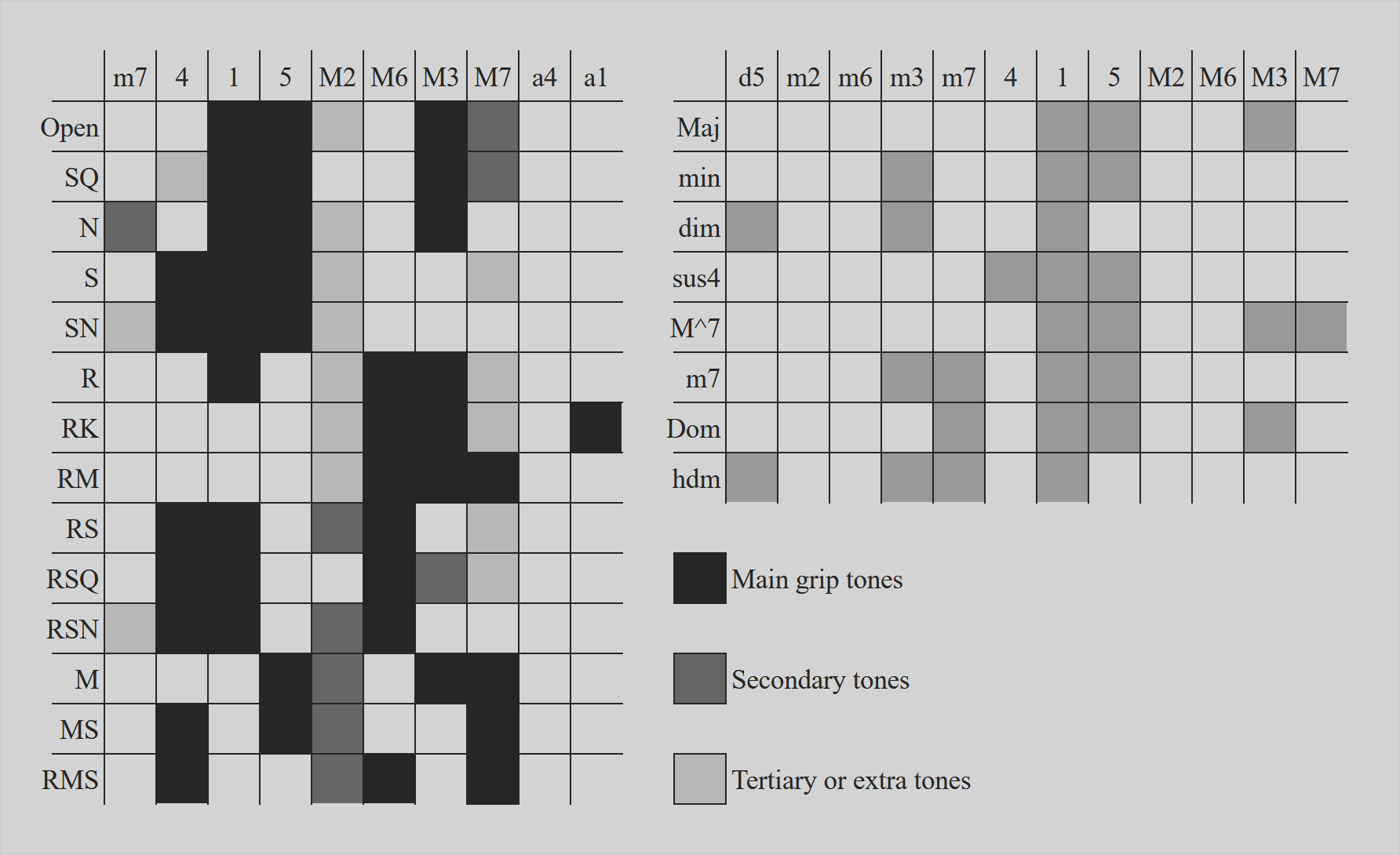
The main grip (10-8-6-5-4-3) only spans three notes at a time. These three are triadic chord tones for most maj/min positions, but RS as mentioned earlier is a bit more complicated. Something to note is that the dominant/half-dim chords each have a different missing tone, MS and RMS lack the 5th and 3rd respectively (both retain their tritone) while N lacks the 7th. The tertiary chord tones are usually the 7th of the latter triad contained within a 7th chord. For instance, the iii7 chord from the open position is built on M3-5-M7-M2 with the main grip being 1-M3-5, so the M2 would be a tertiary tone.
In order to keep things organized, I had to divide the chord charts into three distinct sections: diatonic, darker non-diatonic and lighter non-diatonic (the first chart on this page shows how relative light/dark-ness is determined). Open and RSQ major chords are implied to not have 7ths whenever the chord has a dominant counterpart from MS, such as the V and VII chords, since their major 7ths are out of key (slight caveat to this for the modal positions: whether or not they're in key will depend on which scale is being used). The only S position suspended chords included are the ones that serve as predominants for their respective MS 7 chord at the same fret. These are always a fifth apart; for instance, Isus4 and V7. I haven't found any obvious utility for RM suspended chords yet so I've neglected filling in that row for non-diatonics.
The MS position works as a valid modal position as long as you avoid resolving to the open IV chord (I've still included this chord on the chart anyways, just for the sake of consistency). This also applies to some of the other positions regarding relation to whatever the open chord is, albeit to a lesser extent. I would suggest modulating down a bit by using N and borrowing dorian/minor chords to avoid pulling to the major scale. Example of what I mean (not steel, but close enough)
Functions / alternate names
II7 - V7/V
III7 - V7/vi
(b)VII - IV/IV
iio - iv6
bII7 or #I7 - tritone sub of V7
(b)VI7 or #V7 - tritone sub of V7/V
There's nothing here that isn't included on the charts above, it's just a display of all those chords relative to fretboard position. Sharps/flats will either be based on the major or minor scale, whichever made the most sense for each.
Some combinations have more melodic utility than chordal, particularly those with grip tones that form a suspended chord. Notably, the tones in SN form a pentatonic scale (the only one possible, and I'm certain of this since 5 and M6 are mutually exclusive unless N is modified to drop to M6), and as such can be shifted 3 different ways to fit within the range of a single key. The center will always be offset by +2st from wherever the starting position is, and each additional modulation will have a difference of ±5 from that point (-5 towards a brighter group and +5 for darker). On the chart below I’ve chosen for the central mode to be the one that is natural to each position, so major/minor are slightly off-center for the latter three. To account for this I’ve added an extra modulation for each.
Major range: 4-M7; minor range: m6-M2
This was originally only intended for personal reference. I promise it all makes sense
This is my attempt at listing out all of the relevant chords and variations relative to multiple positions, accounting for implicit modal quality (ie beyond just maj/min). For the sake of brevity, there's no tablature whatsoever here; grips will have to be inferred from the interval chart. I've tried my best to be thorough, but there are more than likely a few mistakes here and there so if anything looks to be obviously wrong, trust your judgement. I'll of course continue to expand this page as I figure more stuff out.
It's worth mentioning that I don't know much of anything about C6, and I don't have much interest in learning about it since I don't have access to a double neck. Also, just looking at the copedent, I get the impression that it's bespoke to a specific play style due to it having irregular combinations instead of uniform chord changes, so it likely wouldn't fit with the system that I've set up for E9.
Everything here will be based on a slight variation of the Emmons E9 copedent with three pedals and four levers. I've given each change a new letter since I wanted to reserve A-G exclusively for note and chord names and I've seen E and D used interchangeably for the EvD# drop. I figured that regardless of the naming scheme I use it'll end up being confusing to some degree no matter what, so I'll just make one that makes sense to me.
| P1 | P2 | P3 | Levers [setup info] | ||||
|---|---|---|---|---|---|---|---|
| aka | A | B | C | F | E/D | G | D |
| "R" | "S" | - | "K" | "M" | "Q" | "N" | |
| Relative | Suspension | Chromatic | Mediant | Oblique | Dominant | ||
| F# | G# +2 (2^3) | ||||||
| D# | D -1 (7vb7) | ||||||
| G# | A +1 (3^4) | ||||||
| E | F# +2 (1^2) | E#/F +1 | D# -1 (1v7) | ||||
| B | C# +2 (5^6) | C# +2 (5^6) | |||||
| G# | A +1 (3^4) | ||||||
| F# | G# +2 (2^3) | ||||||
| E | E#/F +1 | D# -1 (1v7) | |||||
| D# | D -1 (7vb7) | ||||||
| B | C# +2 (5^6) | ||||||
It seems to be standard for the 9th string to be D nat and for N to detune it quite far, but I've decided to match this lower drop with the upper one in order to keep things consistent. This could be modified to instead drop to the 6th in order to retain the 5th when it would usually be replaced by R, but I haven't really looked into that. Also, I don't have the vertical BvA# lever, so that isn't accounted for even though it looks to be quite useful (it would essentially serve a similar purpose to N, just in the opposite direction). The third pedal isn't included for now since it doesn't fit neatly into my system, and I honestly don't like how that motion sounds anyways.
Most of the diatonic chords pair cleanly with a single combination, Sevenths are available for every position except for R/RK.
| I | ii | iii | IV | V7 | vi | viio | |
|---|---|---|---|---|---|---|---|
| Open | RS* | M | RS(Q) | MS | R | RMS | |
| F# | M2 | 1 | m7 | M7 | 3 | 4 | m3 |
| D# | M7 N-m7 | M6 | 5 N-d5 | a4 N-4 | M3 | M2 | 1 |
| G# | M3 | m3 | 1 | 1 | m7 | 5 | d5 |
| E | 1 | m7 | 5 | 5 | M3 | m3 K-M3 | 1 |
| B | 5 | 5 | m3 | M3 | 1 | 1 | m7 |
| G# | M3 | m3 | 1 | 1 | m7 | 5 | d5 |
| F# | M2 | 1 | m7 | M7 | 5 | 4 | m3 |
| E | 1 | m7 | 5 | 5 | M3 | m3 K-M3 | 1 |
| D# | M7 N-m7 | M6 | 5 N-d5 | a4 N-4 | M3 | M2 | 1 |
| B | 5 | 5 | m3 | M3 | 1 | 1 | m7 |
*The ii7 chord is technically the main chord of the RS position but due to its irregular grip it functions as a IV6 chord (Q isn't required for the IV triad, since it provides the 7th). Similar situation with 3-5-7 triads, I've made a chart for them on my modal page but I won't be taking them into account here.
There will always be 5 or fewer intervals in each combination. M and Q tend to merge intervals, subtracting one each. N will add one back when used with M, but this will create two qualities of the same note (one being in key and the other having an accidental) which is very dissonant.
The main grip (10-8-6-5-4-3) only spans three notes at a time. These three are triadic chord tones for most maj/min positions, but RS as mentioned earlier is a bit more complicated. Something to note is that the dominant/half-dim chords each have a different missing tone, MS and RMS lack the 5th and 3rd respectively (both retain their tritone) while N lacks the 7th. The tertiary chord tones are usually the 7th of the latter triad contained within a 7th chord. For instance, the iii7 chord from the open position is built on M3-5-M7-M2 with the main grip being 1-M3-5, so the M2 would be a tertiary tone.
In order to keep things organized, I had to divide the chord charts into three distinct sections: diatonic, darker non-diatonic and lighter non-diatonic (the first chart on this page shows how relative light/dark-ness is determined). Open and RSQ major chords are implied to not have 7ths whenever the chord has a dominant counterpart from MS, such as the V and VII chords, since their major 7ths are out of key (slight caveat to this for the modal positions: whether or not they're in key will depend on which scale is being used). The only S position suspended chords included are the ones that serve as predominants for their respective MS 7 chord at the same fret. These are always a fifth apart; for instance, Isus4 and V7. I haven't found any obvious utility for RM suspended chords yet so I've neglected filling in that row for non-diatonics.
The MS position works as a valid modal position as long as you avoid resolving to the open IV chord (I've still included this chord on the chart anyways, just for the sake of consistency). This also applies to some of the other positions regarding relation to whatever the open chord is, albeit to a lesser extent. I would suggest modulating down a bit by using N and borrowing dorian/minor chords to avoid pulling to the major scale. Example of what I mean (not steel, but close enough)
| Diatonic | Open | R/RK | RS(Q) | M | MS |
|---|---|---|---|---|---|
| v Change | Major | Minor | Maj w/ lydian | Min w/ phrygian | Maj w/ mixolydian |
| Open | I IV (+5) V (-5) | III VI (+5) VII (-5) | V IV (-2) I (+5) II (-5) | VI VII (+2) bII (+5) III (-5) | IV V (+2) bVII (+5) I (-5) |
| RS(Q) | IV V (+2) I (-5) | VI VII (+2) III (-5) | I II (+2) IV (+5) V (-5) | bII III (+2) VII (-3) VI (-5) | bVII I (+2) V (-3) IV (+5) |
| RK | V (-2) I (+3) IV (-4) | VII (-2) III (+3) VI (-4) | IV (+1) II (-2) V (+3) I (-4) | III (-2) VI (+3) bII (-4) VII (+5) | I (-2) IV (+3) bVII (-4) V (+5) |
| R | vi ii (+5) iii (-5) | i iv (+5) v (-5) | iii ii (-2) vi (+5) vii (-5) | iv v (+2) vii (+5) i (-5) | ii iii (+2) v (+5) vi (-5) |
| M | iii ii (-2) vi (+5) | v iv (-2) i (+5) | vii vi (-2) ii (+3) iii (+5) | i vii (-2) iv (+5) v (-5) | vi v (-2) ii (+5) iii (-5) |
| MS | V7 | VII7 | II7 V7 (+5) | III7 VII7 (-5) | I7 V7 (-5) |
| N | V7 (-5) | VII7 (-5) | V7 II7 (-5) | VII7 (+2) III7 (-5) | V7 (+2) I7 (-5) |
| RMS | viio | iio | #ivo viio (+5) | vo iio (-5) | iiio viio (-5) |
| S | Is4 [IVs2] | IIIs4 [VIs2] | Vs4 [Is2] Is4 [IVs2] (+5) | VIs4 [bIIs2] IIIs4 [VIs2] (-5) | IVs4 [VIIs2] Is4 [IVs2] (-5) |
| RM | iiis4 [vis2] | vs4 [is2] | viis4 [iiis2] | is4 [ivs2] | vis4 [iis2] |
| Non-dtc b | Open | R/RK | RS(Q) | M | MS |
|---|---|---|---|---|---|
| v Change | Major | Minor | Maj w/ lydian | Min w/ phrygian | Maj w/ mixolydian |
| Open | bII (+1) bVII (-2) bIII (+3) | bII (-2) bV (+3) | bVII (+3) bIII (-4) | bV (-2) | bIII (-2) bIV (+3) bII (-4) |
| RS(Q) | bIII (-2) bII (-4) bVII (+5) | bV (-2) bII (+5) | bVII (-2) bIII (+3) | bV (+5) | bVI (-2) bII (+3) bIII (+5) |
| RK | bVII (+1) bII (+4) bIII (±6) | bII (+1) bV (±6) | bIII (-1) bVII (±6) | bV (+1) | bIII (+1) bII (-1) bVI (±6) |
| R | v (-2) i (+3) iv (-4) | vii (-2) iii (+3) | iv (+1) v (+3) i (-4) | iii (-2) vi (+3) | i (-2) iv (+3) |
| M | iv (+1) v (+3) i (-4) | vii (+3) iii (-4) | i (+1) v (-4) iv (±6) | iii (+3) vi (-4) | i (+3) iv (-4) |
| MS | bVI7 (+1) IV7 (-2) I7 (+5) bII7 (±6) | VI7 (-2) bII7 (+3) III7 (+5) | bII7 (-1) I7 (-2) | bII7 (-2) VI7 (+5) | bII7 (+1) bVI7 (-4) IV7 (+5) |
| N | I7 bII7 (+1) bVI7 (-4) IV7 (+5) | III7 bII7 (-2) VI7 (+5) | IV7 (-2) bVI7 (+1) | VI7 bII7 (+5) | IV7 bVI7 (+3) bII7 (-3) |
| RMS | io (+1) vio (-2) iio (+3) iiio (+5) | io (-2) vo (+5) | iiio (-2) vio (+3) | ivo (-2) io (+5) | iio (-2) vio (+5) |
| S | bIIs4 [bVs2] (+1) bVIIs4 [bIIIs2] (-2) IVs4 [bVIIs2] (+5) bVs4 [bIs2] (±6) | bIIs4 [bVs2] (-2) bVs4 [bIs2] (+3) VIs4 [bIIs2] (+5) | bVs4 [bIs2] (-1) IVs4 [bVIIs2] (-2) | bVs4 [bIs2] (-2) bIIs4 [bVs2] (+5) | bVs4 [bIs2] (+1) IVs4 [bVIIs2] (-4) bVIIs4 [bIIIs2] (+5) |
| RM |
| Non-dtc # | Open | R/RK | RS(Q) | M | MS |
|---|---|---|---|---|---|
| v Change | Major | Minor | Maj w/ lydian | Min w/ phrygian | Maj w/ mixolydian |
| Open | II (+2) VI (-3) III (+4) | IV (+2) I (-3) V (+4) | VI (+2) III (-3) | IV (-3) I (+4) | _ |
| RS(Q) | III (-1) II (-3) VI (+4) | V (-1) IV (-3) I (+4) | VI (-3) III (+4) | I (-1) IV (+4) | _ |
| RK | VI II (+5) III (-5) | I IV (+5) V (-5) | III VI (+5) | IV I (-5) | II |
| R | vii (+2) #iv (-3) #i (+4) | ii (+2) #vi (-3) #iii (+4) | #iv (+2) #i (-3) | _ | _ |
| M | #iv (+2) #i (-3) vii (-5) | #vi (+2) #iii (-3) ii (-5) | #i (+2) #iv (-5) | _ | _ |
| MS | III7 (-3) II7 (-5) | I7 (+2) V7 (-3) IV7 (-5) | III7 (+2) VI7 (-5) | V7 (+4) | _ |
| N | II7 (+2) III7 (+4) | IV7 (+2) I7 (-3) V7 (+4) | VI7 (+2) III7 (-3) | _ | _ |
| RMS | #io (+2) #ivo (-5) | #iiio (+2) #vio (-5) | #io (-5) | _ | _ |
| S | VIs4 [IIs2] (-3) Vs4 [Is2] (-5) | IVs4 [VIIs2] (+2) Is4 [IVs2] (-3) VIIs4 [IIIs2] (-5) | VIs4 [IIs2] (+2) IIs4 [Vs2] (-5) | Is4 [IVs2] (+4) | _ |
| RM | _ | _ | _ | _ | _ |
Functions / alternate names
II7 - V7/V
III7 - V7/vi
(b)VII - IV/IV
iio - iv6
bII7 or #I7 - tritone sub of V7
(b)VI7 or #V7 - tritone sub of V7/V
There's nothing here that isn't included on the charts above, it's just a display of all those chords relative to fretboard position. Sharps/flats will either be based on the major or minor scale, whichever made the most sense for each.
| -5 | -4 | -3 | -2 | -1 | Open pos | +1 | +2 | +3 | +4 | +5 | ±6 | |
|---|---|---|---|---|---|---|---|---|---|---|---|---|
| Open | V | VI | bVII | I | bII | II | bIII | III | IV | |||
| RS | I | bII | II | bIII | III | IV | V | VI | bVII | |||
| RK | III | IV | V | VI | bVII | I | bII | II | bIII | |||
| R | iii | iv | #iv | v | vi | vii | i | #i | ii | |||
| M | vii | i | #i | ii | iii | iv | #iv | v | vi | |||
| MS | II7 | III7 | IV7 | V7 | bVI7 | I7 | bII7 | |||||
| N | V7 | bVI7 | I7 | bII7 | II7 | III7 | IV7 | |||||
| RMS | #ivo | vio | viio | io | #io | iio | iiio | |||||
| S | Vs4 | VIs4 | bVIIs4 | Is4 | bIIs4 | IVs4 | bVs4 | |||||
| RM | iiis4 |
| -5 | -4 | -3 | -2 | -1 | R pos | +1 | +2 | +3 | +4 | +5 | ±6 | |
|---|---|---|---|---|---|---|---|---|---|---|---|---|
| Open | VII | I | bII | III | IV | bV | V | VI | ||||
| RS | III | IV | bV | V | VI | VII | I | bII | ||||
| RK | V | VI | VII | I | bII | III | IV | bV | ||||
| R | v | #vi | vii | i | ii | iii | #iii | iv | ||||
| M | ii | iii | #iii | iv | v | #vi | vii | i | ||||
| MS | IV7 | V7 | VI7 | VII7 | I7 | bII7 | III7 | |||||
| N | VII7 | I7 | bII7 | III7 | IV7 | V7 | VI7 | |||||
| RMS | #vio | io | iio | #iiio | vo | |||||||
| S | VIIs4 | Is4 | bIIs4 | IIIs4 | IVs4 | bVs4 | VIs4 | |||||
| RM | vs4 |
| -5 | -4 | -3 | -2 | -1 | RS pos | +1 | +2 | +3 | +4 | +5 | ±6 | |
|---|---|---|---|---|---|---|---|---|---|---|---|---|
| Open | _ | |||||||||||
| RS | _ | |||||||||||
| RK | _ | |||||||||||
| R | _ | |||||||||||
| M | _ | |||||||||||
| MS | _ | |||||||||||
| N | _ | |||||||||||
| RMS | _ | |||||||||||
| S | _ | |||||||||||
| RM | _ |
| -5 | -4 | -3 | -2 | -1 | M pos | +1 | +2 | +3 | +4 | +5 | ±6 | |
|---|---|---|---|---|---|---|---|---|---|---|---|---|
| Open | _ | |||||||||||
| RS | _ | |||||||||||
| RK | _ | |||||||||||
| R | _ | |||||||||||
| M | _ | |||||||||||
| MS | _ | |||||||||||
| N | _ | |||||||||||
| RMS | _ | |||||||||||
| S | _ | |||||||||||
| RM | _ |
| -5 | -4 | -3 | -2 | -1 | MS pos | +1 | +2 | +3 | +4 | +5 | ±6 | |
|---|---|---|---|---|---|---|---|---|---|---|---|---|
| Open | _ | |||||||||||
| RS | _ | |||||||||||
| RK | _ | |||||||||||
| R | _ | |||||||||||
| M | _ | |||||||||||
| MS | _ | |||||||||||
| N | _ | |||||||||||
| RMS | _ | |||||||||||
| S | _ | |||||||||||
| RM | _ |
Some combinations have more melodic utility than chordal, particularly those with grip tones that form a suspended chord. Notably, the tones in SN form a pentatonic scale (the only one possible, and I'm certain of this since 5 and M6 are mutually exclusive unless N is modified to drop to M6), and as such can be shifted 3 different ways to fit within the range of a single key. The center will always be offset by +2st from wherever the starting position is, and each additional modulation will have a difference of ±5 from that point (-5 towards a brighter group and +5 for darker). On the chart below I’ve chosen for the central mode to be the one that is natural to each position, so major/minor are slightly off-center for the latter three. To account for this I’ve added an extra modulation for each.
| SN pos | Open | R | RS | M | MS |
|---|---|---|---|---|---|
| >> (+4) | M2-M6-M3-M7-a4 | 4-1-5-M2-M6 | M6-M3-M7-a4-a1 | m7-4-1-5-M2 | 5-M2-M6-M3-M7 |
| > (-3) | 5-M2-M6-M3-M7 | m7-4-1-5-M2 | M2-M6-M3-M7-a4 | m3-m7-4-1-5 | 1-5-M2-M6-M3 |
| Cntr (+2) | 1-5-M2-M6-M3 | m3-m7-4-1-5 | 5-M2-M6-M3-M7 | m6-m3-m7-4-1 | 4-1-5-M2-M6 |
| < (-5) | 4-1-5-M2-M6 | m6-m3-m7-4-1 | 1-5-M2-M6-M3 | m2-m6-m3-m7-4 | m7-4-1-5-M2 |
| << (0) | m7-4-1-5-M2 | m2-m6-m3-m7-4 | 4-1-5-M2-M6 | d5-m2-m6-m3-m7 | m3-m7-4-1-5 |
Major range: 4-M7; minor range: m6-M2
This was originally only intended for personal reference. I promise it all makes sense